Understanding eye health
Glaucoma: symptoms, diagnosis and treatment

Written by Dr. Tom Liba
Glaucoma damages the optic nerve.

The key points
Briefly
Glaucoma is a progressive disease that damages the optic nerve and can lead to vision loss.
Early stages are often asymptomatic; diagnosis involves a comprehensive eye exam including intraocular pressure measurement, optic nerve assessment, and imaging tests.
Treatment aims to lower intraocular pressure using drops, laser, or surgery, to prevent further damage and preserve existing vision.
In detail
What is Glaucoma?
Glaucoma is a disease that damages the optic nerve, which is responsible for transmitting visual information from the eye to the brain. This damage can lead to irreversible vision loss. While often associated with high intraocular pressure, glaucoma can also develop with normal eye pressure. In its early stages, peripheral vision is typically affected first, with central vision preserved until very advanced stages. Consequently, many individuals do not experience symptoms until significant damage has already occurred.
Main Types of Glaucoma
Glaucoma types are generally classified based on the condition of the eye's drainage angle, located between the cornea and the iris. Open angle glaucoma is the most common type, where the angle appears open but does not function properly, leading to a gradual increase in pressure. Normal tension glaucoma is a form of open angle glaucoma where optic nerve damage occurs despite intraocular pressure being within the normal range. Angle closure glaucoma happens when the drainage angle becomes blocked, sometimes suddenly and acutely, causing a rapid and significant rise in intraocular pressure.
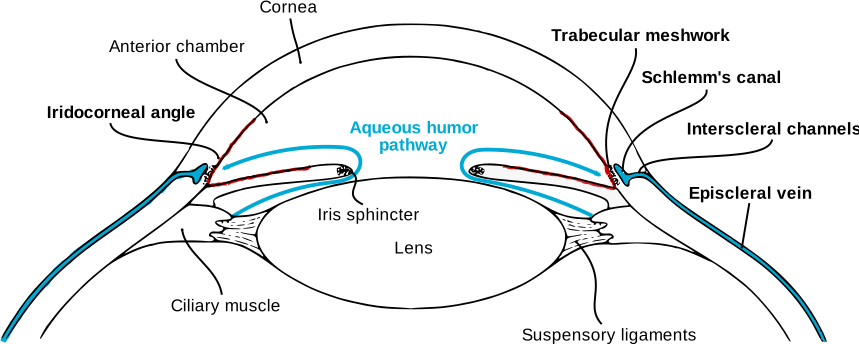
The fluid pathway at the front of the eye. Fluid forms behind the iris, passes through the pupil and drains at the angle between the iris and cornea. Impaired drainage can raise pressure, but glaucoma can also occur with a pressure reading in the normal range.
Image: ignaciorlando · Image source · CC0 1.0 · Used without modification
Risk Factors and Symptoms
The primary cause of optic nerve damage in most glaucoma cases is elevated intraocular pressure, resulting from impaired drainage of eye fluid. Risk factors include age 40 and above, genetic predisposition, and a family history of glaucoma. Most types of glaucoma, such as open angle glaucoma and chronic angle closure glaucoma, are asymptomatic in their early stages. In advanced stages, peripheral vision loss may occur. Acute angle closure glaucoma presents with severe and sudden eye pain, redness, blurred vision, halos around lights, and sometimes nausea and vomiting.
Diagnosing Glaucoma
Early diagnosis is crucial to prevent irreversible damage. Diagnosis involves several tests: intraocular pressure measurement using a tonometer, examination of the optic nerve head to assess its condition, and visual field testing to identify areas of peripheral vision loss. If glaucoma is suspected, additional tests like Optical Coherence Tomography (OCT) will be performed. OCT provides a detailed scan of the optic nerve and allows for monitoring of nerve fiber layer thickness. These tests combined provide a comprehensive picture of the disease state.
Treatment Options
The goal of treatment is to lower intraocular pressure and preserve existing vision, as damage already sustained by the optic nerve is irreversible. Initial treatment often involves eye drops that either reduce fluid production or improve its drainage. In some cases, laser treatments may be performed, such as Selective Laser Trabeculoplasty (SLT) for open angle glaucoma, or YAG laser iridotomy for angle closure glaucoma. These laser procedures create openings or improve the function of the eye's drainage system.
Surgical Treatments
When drops or laser do not control the disease sufficiently, or when glaucoma is advanced, surgery may be considered. Trabeculectomy creates a controlled opening under a flap in the white of the eye, allowing fluid to drain into a small reservoir beneath the conjunctiva called a bleb. It does not remove all of the blocked drainage channels. A glaucoma drainage implant uses a tube connected to a plate to direct fluid out of the eye. Some implants contain a valve and others do not.
Minimally invasive glaucoma procedures often work on the existing drainage pathways and may be suitable for selected people with mild or moderate disease, sometimes alongside cataract surgery. Their pressure lowering effect and suitability differ from trabeculectomy and tube surgery. The choice depends on the type and severity of glaucoma, the pressure target and previous treatment.
Follow Up and When to Seek Care
Since glaucoma is often asymptomatic in its early stages, regular eye examinations are important, especially for individuals aged 40 and above. The frequency of these examinations depends on risk factors and age. If the disease is diagnosed and treated appropriately, its progression can be slowed or halted. In the event of acute symptoms such as severe and sudden eye pain, significant redness, sudden blurred vision, or nausea and vomiting, immediate emergency eye assessment is necessary, as these may indicate an acute glaucoma attack.
Medical sources
More information for you
Eye tests
Eye pressure (intraocular pressure)
Eye pressure is the fluid pressure inside the eye. Learn what counts as normal, why high pressure matters for glaucoma, and how it is measured.
Read more
Eye tests
Visual field test: how it works
A test that looks for missing areas in side or central vision.
Read more
Eye tests
OCT eye scan: what it is and what it shows
A non invasive light based scan of the retina, optic nerve or cornea.
Read more
Treatments and surgery
Trabeculectomy glaucoma surgery
Trabeculectomy lowers pressure when glaucoma needs stronger control or other options are insufficient.
Read more
Treatments and surgery
Laser iridotomy
Iridotomy is considered for selected narrow or closed drainage angles, not every glaucoma type.
Read more
Treatments and surgery
GATT glaucoma surgery
GATT lowers pressure in selected glaucomas depending on angle anatomy and the pressure target.
Read moreTom Liba, M.D.
Contact
For questions and further information, you can contact me by email.
tomliba1996@gmail.com