Understanding eye health
Scleral contact lenses

Written by Dr. Tom Liba
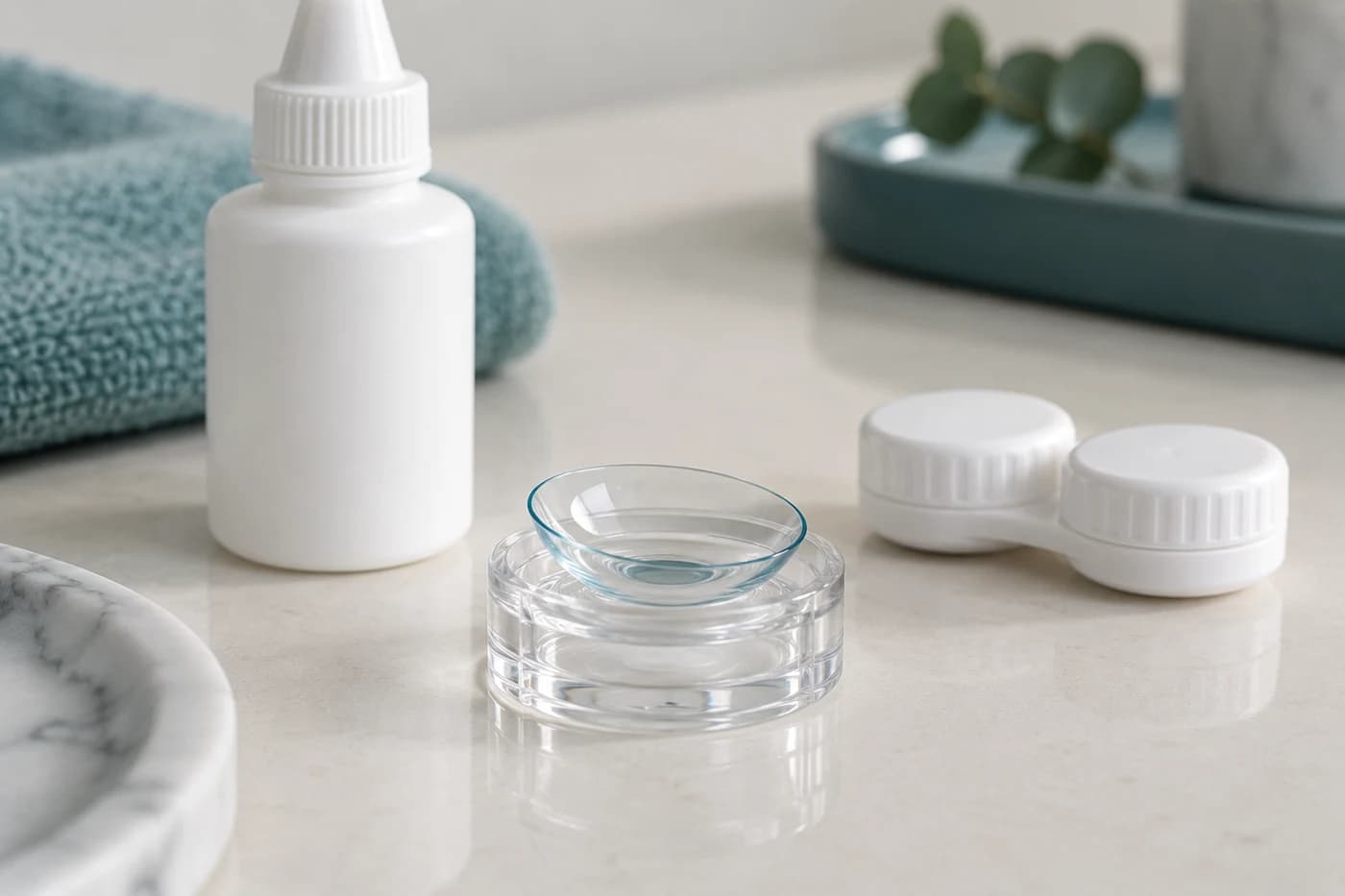
Large scleral lenses rest on the white of the eye and vault over an irregular cornea.
The key points
Briefly
Scleral lenses are large contact lenses that rest on the white of the eye, vaulting over the cornea.
They create a fluid reservoir between the lens and the cornea, improving the optical surface and providing comfort.
Custom fitting, strict hygiene, and regular follow up are crucial for preventing complications and maintaining eye health.
In detail
What are Scleral Lenses?
Scleral lenses are a specialized type of contact lens with a larger diameter than conventional contact lenses. Unlike standard rigid gas permeable or soft lenses, scleral lenses do not rest directly on the cornea. Instead, they rest on the white part of the eye, known as the sclera. This design creates a vault over the cornea, leaving a small, fluid filled space between the lens and the corneal surface. This unique structure allows them to provide both optical and functional benefits for various eye conditions.
Who Can Benefit from Scleral Lenses?
Scleral lenses are primarily indicated for individuals with irregular corneas, a condition where the corneal shape is not smooth or uniform. Such conditions include keratoconus, where the cornea thins and bulges forward into a cone shape, or irregular astigmatism. They are also suitable after certain eye surgeries, such as corneal transplants, or in cases of corneal injury. Additionally, scleral lenses can be beneficial for people suffering from severe dry eye, as the fluid reservoir beneath the lens helps maintain corneal hydration.
How Do They Improve Vision?
The main advantage of scleral lenses lies in their ability to create a smooth, uniform optical surface over an irregular cornea. The fluid reservoir between the lens and the cornea fills in any irregularities of the corneal surface, thereby neutralizing the negative effects of its uneven shape on vision. This results in a significant improvement in visual acuity, reduction of blur, distortions, and double vision, leading to clearer and more stable vision. Furthermore, these lenses are more stable on the eye and generally more comfortable than traditional rigid gas permeable lenses, as they do not directly touch the sensitive cornea.
The Fitting Process
Fitting scleral lenses is a personalized and precise process, performed by a specialized optometrist. The process involves a comprehensive eye examination, accurate measurements of the corneal and scleral shape, and the selection of trial lenses. The goal of the fitting is to find a lens that rests comfortably on the sclera, creates an optimal fluid reservoir over the cornea, and provides the best possible optical correction. Once the appropriate lens is selected, it is custom ordered and manufactured.
Instruction for Use and Maintenance
After receiving the custom fitted lenses, patients undergo thorough training on how to insert and remove the lenses, which differs from regular contact lenses. It is crucial to learn how to fill the lens with the sterile, preservative free saline recommended by the fitting team before insertion. Cleaning or disinfecting solution must not be used as the fluid placed against the eye. Training also covers safe lens removal. Additionally, detailed instructions are provided regarding cleaning, disinfecting, and storing the lenses. Adherence to proper hygiene and the use of specific solutions are essential to prevent infections and other complications. Tap water should never be used for cleaning or rinsing the lenses or their case, and lenses should not be worn overnight unless explicitly instructed by a professional.
Potential Risks and Complications
As with any contact lens use, there are certain risks associated with scleral lenses, although they are relatively rare when instructions are followed diligently. The primary complication is corneal infection, which can result from poor hygiene or improper use. Other potential complications include eye irritation, redness, increased light sensitivity, or deposit buildup on the lens. It is important to adhere to hygiene rules, use only recommended solutions, and avoid sleeping in the lenses to minimize these risks.
Follow Up and When to Seek Medical Attention
After beginning to use scleral lenses, regular follow up appointments with the optometrist or ophthalmologist are necessary to ensure the lenses continue to fit well and that the eyes remain healthy. In case of redness, pain, increased light sensitivity, eye discharge, sudden decrease in vision, or any unusual discomfort, the lens should be immediately removed, and urgent medical attention sought. These symptoms could indicate a complication requiring immediate treatment.
Medical sources
More information for you


Tom Liba, M.D.
Contact
For questions and further information, you can contact me by email.
tomliba1996@gmail.com