Understanding eye health
Eyelid surgery (blepharoplasty)

Written by Dr. Tom Liba
Excess eyelid skin or fat may affect the visual field or appearance; assessment distinguishes skin excess from ptosis.

The key points
Briefly
Blepharoplasty removes excess eyelid skin and fat, improving visual field and appearance.
Preparation includes an individualized medical and medication review; the procedure is often performed under local anesthesia.
Recovery includes swelling and bruising; seek medical attention for severe pain, rapid swelling, or vision changes.
In detail
What is Blepharoplasty?
Blepharoplasty is a surgical procedure designed to remove excess skin, muscle, and fat from the upper or lower eyelids. Accumulation of excess tissue in the upper eyelids can obstruct the upper visual field, cause a sensation of heaviness and fatigue in the eyes, and contribute to an aged or tired appearance. In the lower eyelids, excess fat often creates the appearance of "bags" under the eyes. The surgery aims to improve both the functional and aesthetic aspects of the eyes.
Who is a Candidate for Treatment?
This treatment is suitable for individuals experiencing excess eyelid skin or fat that interferes with their visual field or causes aesthetic concern. Before surgery, a thorough evaluation is conducted to determine if the problem stems from excess skin (dermatochalasis), eyelid drooping (ptosis), or eyebrow ptosis. Often, addressing multiple factors is necessary to achieve the best possible outcome.
Preparation for Surgery
Before surgery, the team assesses your eye health, vision, eyelid function and any dry eye symptoms. Blood tests or other investigations are selected according to your medical history, the procedure and anesthesia plan. Tell the surgeon about chronic conditions, allergies, previous operations and every medicine and supplement you take.
Management of medicines that affect bleeding, including aspirin and anticoagulants, must be agreed with the surgeon and prescribing clinician. Do not stop them on your own or follow a fixed schedule from a general information page. The team balances bleeding risk against the risk of clots, stroke or heart problems. Stopping smoking supports healing; ask for your personal preparation instructions.
How the Surgery is Performed
The surgery is usually performed under local anesthesia, though general anesthesia can also be used. Before the procedure begins, the surgeon carefully marks the areas of excess skin and fat to be removed. For the upper eyelid, an incision is made along the natural crease, through which excess skin, muscle, and fat pads are removed. For the lower eyelid, the incision can be external, just below the eyelashes, or internal, inside the eyelid. Finally, the incisions are closed with fine sutures, which are typically removed after about seven to ten days. The duration depends on the number of eyelids treated, the technique and any additional procedures, and most patients are discharged home on the same day.
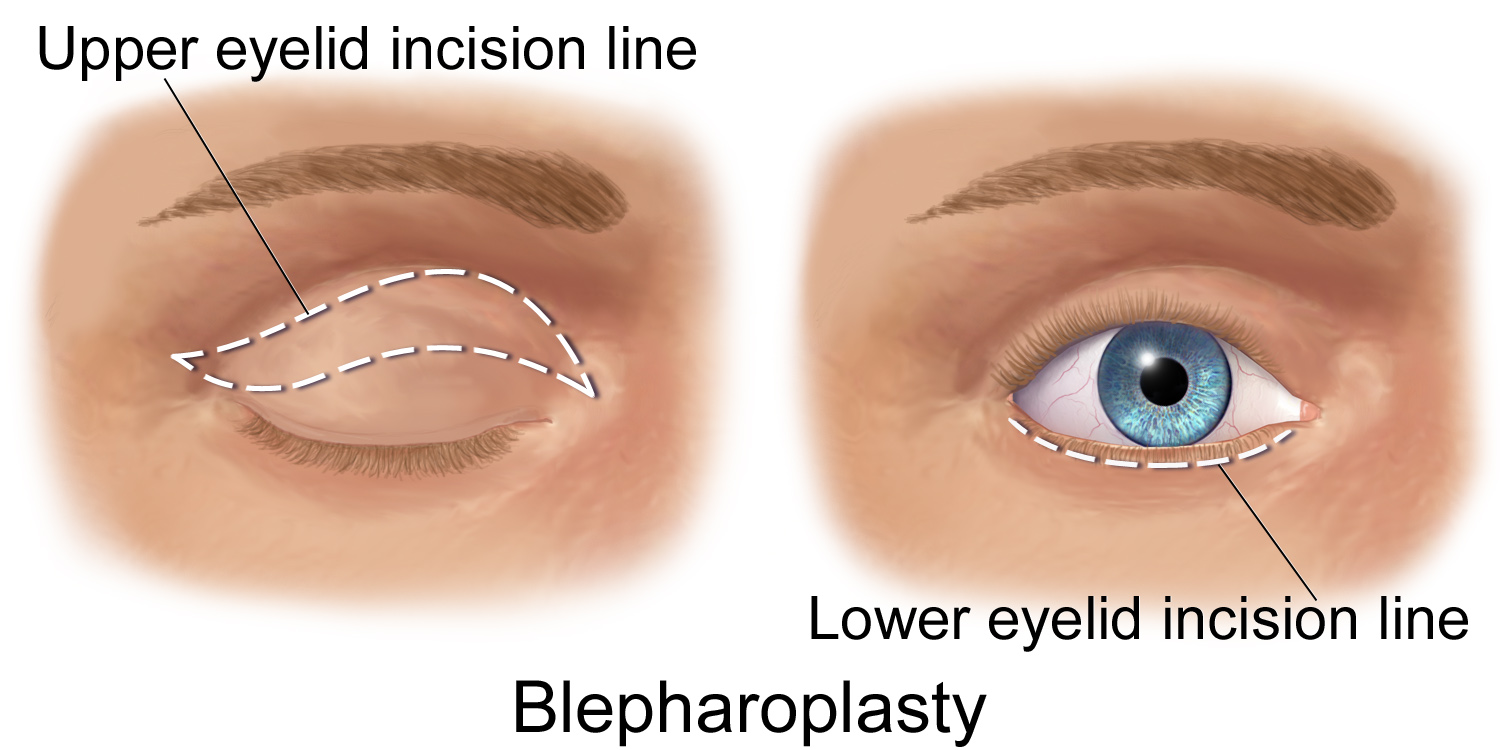
A schematic of possible incision sites in upper and lower eyelid surgery. The approach is selected according to eyelid anatomy and the purpose of surgery.
Image: BruceBlaus, Blausen Medical Communications · Image source · CC BY 3.0 · Used without modification
Potential Risks
As with any surgical procedure, blepharoplasty carries potential risks, although they are uncommon. These risks include bleeding, infection, asymmetry between the eyes, difficulty closing the eye, outward pulling of the eyelid margin (ectropion), and increased dryness or tearing. In very rare cases, vision impairment can occur. It is important to discuss all potential risks and concerns with your surgeon before the procedure.
Recovery and Results
Following surgery, you can expect swelling, mild bruising, and some discomfort around the eyes, which typically resolve within about two weeks. You may also experience redness of the conjunctiva, difficulty reading or watching television, and either tearing or dryness in the eyes. Applying cold compresses to the eyes during the first few hours after surgery is recommended to reduce swelling. You should avoid strenuous physical activity, bending your head down, sun exposure, and eye makeup for the first week. The final results of the surgery are usually evident after several months, once all swelling has subsided and scars have faded.
Follow Up and When to Seek Care
You will be asked to return for suture removal approximately seven to ten days after surgery, and for a follow up visit about one month later. It is crucial to adhere to your surgeon's instructions regarding local care and medication use. You should seek immediate medical attention or go to an emergency room if you experience a fever above 38 degrees Celsius (100.4 F), shortness of breath, severe localized redness, unusual and rapid swelling accompanied by severe pain, or sudden vision loss.
Medical sources
More information for you

Eye conditions
Droopy eyelid (ptosis): causes and care
Ptosis is a low upper eyelid, caused by congenital or acquired changes in lifting muscles or nerves.
Read more
Treatments and surgery
Ptosis surgery: droopy eyelid repair
Repair depends on visual impact, age and the cause of eyelid droop; children need amblyopia assessment.
Read more
Ophthalmology topics
Oculoplastics: eyelid and tear duct care
Eyelids, tear ducts, brows and the tissues around the eye.
Read moreTom Liba, M.D.
Contact
For questions and further information, you can contact me by email.
tomliba1996@gmail.com