Understanding eye health
Uveitis: symptoms, causes and treatment

Written by Dr. Tom Liba
Inflammation inside the eye that can have many causes.

The key points
Briefly
Uveitis is inflammation inside the eye that can affect various parts, including the iris, ciliary body, and choroid.
Symptoms vary depending on the inflammation's location, and may include redness, pain, light sensitivity, blurred vision, or 'floaters'.
Diagnosis involves a comprehensive eye exam, sometimes blood tests or imaging. Treatment is individualized, often involving steroids or immunosuppressants.
In detail
What is Uveitis?
Uveitis is a group of inflammatory diseases affecting the uvea, the middle layer of the eye. This layer consists of the iris (the colored part of the eye), the ciliary body (responsible for producing aqueous humor and focusing the lens), and the choroid (a vascular layer that nourishes the retina). Inflammation in these areas can cause structural damage, impact vision, and lead to serious complications if left untreated.
Types of Uveitis
Uveitis is classified based on the location of inflammation within the eye. Anterior uveitis is the most common type, affecting the iris and ciliary body. Intermediate uveitis involves the vitreous and sometimes the peripheral retina. Posterior uveitis affects the choroid and retina at the back of the eye. Panuveitis is a condition where all parts of the uvea are involved. The disease can be acute (short term), chronic (long lasting), or occur in recurrent episodes, often affecting one or both eyes.
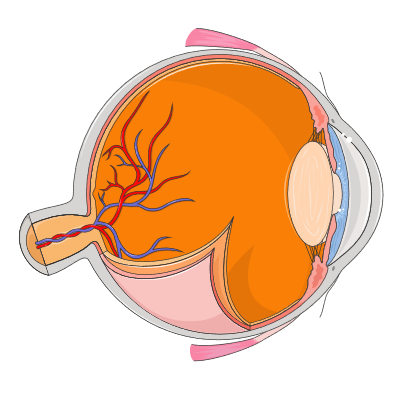
An illustration of eye anatomy. The uvea includes the iris, ciliary body and choroid, and inflammation can affect different parts.
Image: Servier Medical Art · Image source · CC BY 4.0 · Used without modification
Causes and Risk Factors
In many cases, uveitis is associated with autoimmune diseases, where the immune system mistakenly attacks healthy body tissues, including the eye. Examples include arthritis, inflammatory bowel diseases, and psoriasis. Other causes can be various infections, such as viruses (e.g., herpes), bacteria (like syphilis), fungi, or parasites. Rarely, certain medications or malignancies can cause uveitis. In about one third of cases, no specific cause is found, and the condition is termed idiopathic uveitis.
Symptoms
The symptoms of uveitis vary depending on the location and severity of the inflammation. Anterior uveitis typically presents with redness, pain, light sensitivity (photophobia), and blurred vision. Intermediate and posterior uveitis may cause 'floaters' or a decrease in visual acuity, often with less pain or redness. In some cases, particularly with posterior uveitis, there may be few symptoms, or the disease might be discovered incidentally during a routine eye examination. It is important to seek medical attention if these symptoms appear.
Diagnosis
Diagnosing uveitis begins with a comprehensive eye examination by an ophthalmologist, including a slit lamp examination and pupil dilation. During the examination, the doctor will look for signs of inflammation such as inflammatory cells in the intraocular fluid or deposits on various eye structures. Often, additional imaging tests like OCT (Optical Coherence Tomography) or ocular ultrasound will be performed. In many cases, blood tests may be necessary to identify infectious causes or autoimmune diseases, and sometimes systemic imaging like CT or MRI may be required.
Treatment
Treatment for uveitis is individualized based on the cause, location, and severity of the inflammation. In many cases, initial treatment involves corticosteroids, administered as eye drops, injections into or around the eye, oral pills, or intravenous infusion, to suppress the inflammatory response. If an infection is the cause, appropriate antibiotic, antiviral, antifungal, or antiparasitic treatment will be given. For chronic or steroid resistant uveitis, immunomodulatory (immunosuppressive) drugs or novel biologic therapies may be necessary. The goal of treatment is to reduce inflammation, prevent vision damage, and control future flare ups.
Follow Up and When to Seek Medical Care
Regular follow up with an ophthalmologist is crucial for managing uveitis, even after the inflammation subsides. It is important to take medications as prescribed and not to discontinue them without medical advice. You should be vigilant for any changes in vision or the appearance of new or worsening symptoms, such as sudden redness, severe pain, increased light sensitivity, significant vision decrease, or an increase in 'floaters'. In such cases, seek prompt ophthalmological evaluation to prevent potential complications and preserve vision.
Tom Liba, M.D.
Contact
For questions and further information, you can contact me by email.
tomliba1996@gmail.com