Understanding eye health
Optic disc drusen

Written by Dr. Tom Liba
Optic disc drusen are deposits that can make the optic nerve head look elevated.

The key points
Briefly
Optic disc drusen are deposits within the optic nerve head that can make it appear elevated.
Many individuals experience no symptoms, but peripheral vision can sometimes be affected.
Diagnosis involves imaging tests like OCT and ultrasound to differentiate drusen from other conditions.
In detail
What are Optic Disc Drusen?
Optic disc drusen are deposits, often calcified, of material within the optic nerve head, at its entrance into the eyeball. They affect a small proportion of people and can run in families, although their exact cause is not known. These deposits can make the optic nerve head appear elevated, a condition that can mimic true optic disc swelling, including papilledema caused by raised pressure around the brain, which requires a different diagnostic workup.
Development and Symptoms
In childhood, drusen are typically small and deep, making them difficult to observe during a routine examination. As individuals age, they tend to grow and move closer to the surface of the nerve, becoming more readily visible during an eye examination. Many people with drusen experience no symptoms. However, over time, up to seventy percent of people may develop some peripheral visual field loss, which is usually mild. Rarely, transient visual disturbances lasting a few seconds may occur.
Diagnosis and Differentiation
The diagnosis of optic disc drusen is made through a comprehensive eye examination, including careful observation of the optic nerve head. Since drusen can mimic true optic disc swelling, it is crucial to perform additional tests to differentiate between these conditions. True optic disc swelling can indicate more serious medical conditions, such as elevated intracranial pressure, and therefore requires appropriate investigation and treatment.
Ancillary Diagnostic Tests
Several ancillary tests aid in diagnosing drusen and differentiating them from swelling. Optical Coherence Tomography (OCT) provides detailed imaging of the optic nerve layers and can identify the drusen. Fundus autofluorescence can demonstrate drusen as hyperautofluorescent spots. Ocular ultrasound is another effective tool, allowing identification of drusen as hyperechoic deposits within the optic nerve head, including some buried deposits not visible on direct examination. Ultrasound is most useful when the deposits are calcified; a negative test does not always exclude small or uncalcified drusen. The doctor combines the imaging findings with the examination, and additional investigation may still be needed if true swelling is suspected.
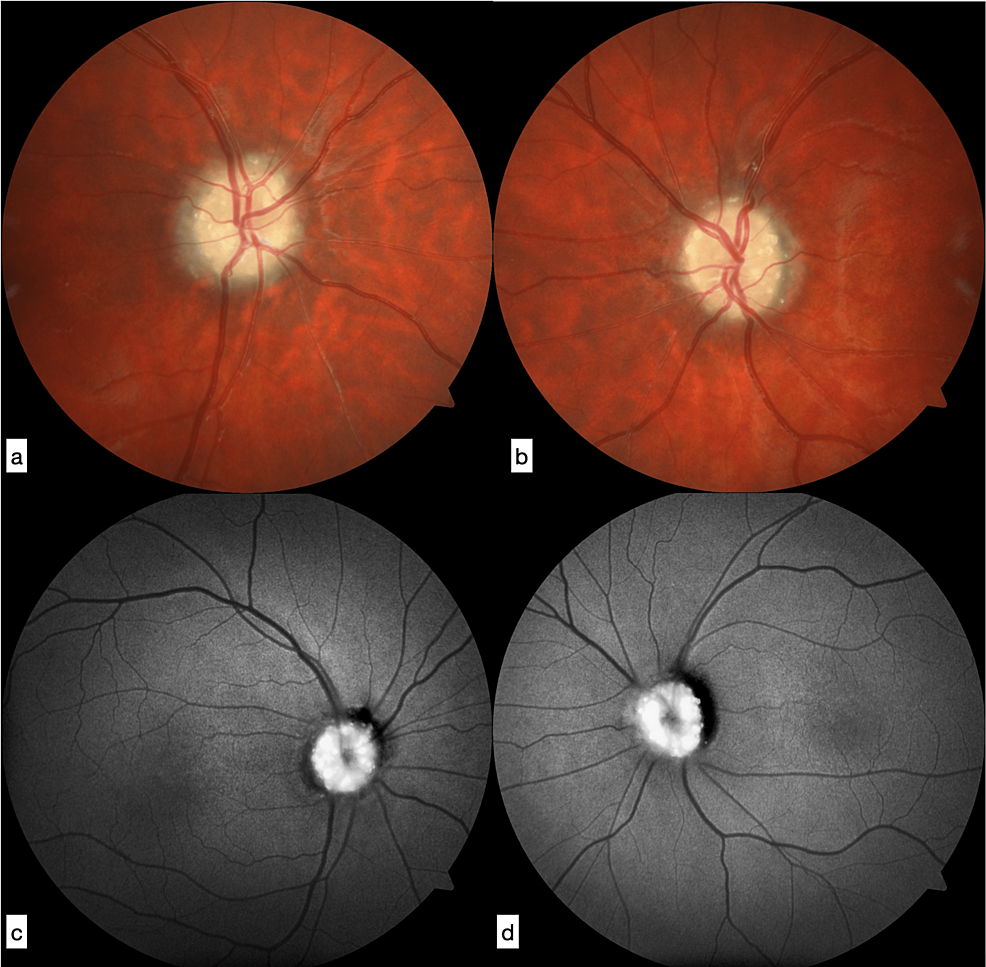
A published clinical example of optic disc drusen. Fundus photographs appear above and autofluorescence images below, highlighting some deposits.
Image: Mohamed Bouazza, Amine Razzak, Mehdi El Jai, Houda Youssefi (2022), Figure 1 · Image source · CC BY 4.0 · Used without modification
Treatment and Management
Currently, there is no proven treatment that can cure optic disc drusen or prevent their growth. Management focuses on monitoring visual function and identifying any changes over time. There is no general recommendation for medical or surgical treatment of the drusen themselves, unless secondary complications develop.
Follow up and When to Seek Care
After a diagnosis of drusen, regular follow up appointments are recommended to monitor the condition of the optic nerve and visual fields. This monitoring helps to identify any changes or development of eye problems related to the drusen. It is important to remember that sudden vision loss, a new significant headache, or any other neurological symptom, requires immediate medical evaluation and should not be automatically attributed to drusen. These symptoms could indicate other medical conditions that require urgent diagnosis and treatment.
More information for you

Eye tests
OCT eye scan: what it is and what it shows
A non invasive light based scan of the retina, optic nerve or cornea.
Read more
Eye tests
Visual field test: how it works
A test that looks for missing areas in side or central vision.
Read more
Eye tests
Fundus autofluorescence imaging
Autofluorescence records natural signals from retinal tissues to assess selected retinal disorders.
Read moreTom Liba, M.D.
Contact
For questions and further information, you can contact me by email.
tomliba1996@gmail.com