Understanding eye health
Macular degeneration (AMD): treatment

Written by Dr. Tom Liba
AMD affects central detailed vision.

The key points
Briefly
AMD affects central vision and the ability to see details.
It has dry and wet forms; the wet form involves abnormal blood vessels.
Treatment depends on the type and stage, often involving monitoring or intravitreal injections.
In detail
What is Age Related Macular Degeneration (AMD)?
Age Related Macular Degeneration (AMD) is a condition that affects the macula, the central part of the retina responsible for sharp, detailed vision. This damage impacts daily activities such as reading, writing, recognizing faces, and driving. AMD develops due to a combination of factors, including the accumulation of cellular waste products, inflammatory processes, degeneration of retinal cells, and the proliferation of abnormal blood vessels.
Types of AMD
AMD has dry and wet forms, and the stage is important. Early and intermediate dry AMD commonly involve deposits called drusen and may cause no symptoms or relatively mild changes. Late dry AMD can include geographic atrophy, with loss of retinal cells and substantial permanent loss of central vision. Not all dry AMD progresses to wet AMD, and an individual's risk depends on their findings rather than a single percentage.
Wet AMD is a form of late AMD in which abnormal blood vessels grow beneath the retina and may leak fluid or blood. This can cause distortion and rapid deterioration of central vision. Without timely treatment, scarring can lead to irreversible loss. Both late dry and wet AMD can seriously affect detailed vision, although peripheral vision usually remains.
Risk Factors
Several factors increase the risk of developing AMD. Age is the primary risk factor, with the condition being more prevalent in individuals over 65. Smoking is a significant risk factor, likely due to the inflammatory processes it triggers. Family history and genetics also play a role. Other contributing factors may include prolonged exposure to sunlight, obesity, and high blood pressure, likely through their effects on blood vessels and inflammatory pathways.
Symptoms
Symptoms of AMD include a decrease in visual acuity, blurred vision, distortion of straight lines, the appearance of a dark spot in the center of the visual field that worsens over time, and reduced contrast sensitivity. This reduced sensitivity can make colors appear faded and cause difficulty adapting to changes between dark and light environments. These symptoms can affect one or both eyes.
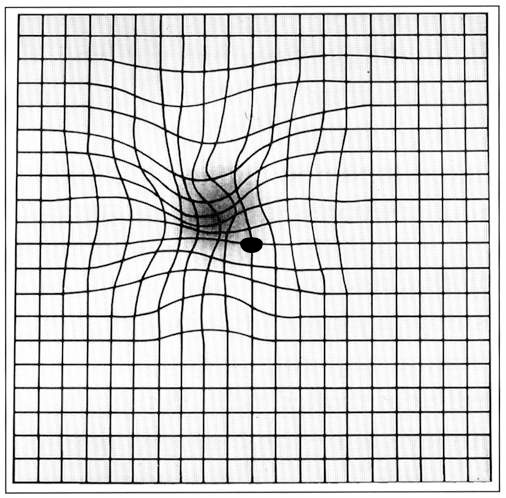
An illustration of straight lines appearing distorted when central vision is affected. This illustrates a symptom and is not a diagnostic self test.
Image: National Eye Institute, NIH · Image source · Public domain, NIH official work · Used without modification
Diagnosis
Early diagnosis of AMD is crucial to prevent significant vision damage or slow the progression of the disease. Diagnosis is performed by an ophthalmologist and involves a comprehensive eye and retinal examination using a slit lamp. Advanced imaging tests such as Optical Coherence Tomography (OCT) are also performed, providing detailed cross sectional images of the retina. In some cases, fluorescein angiography or OCTA may be required to visualize the retinal blood vessels.
Treatment Options
Treatment for AMD depends on the type and stage of the disease. For early stages of dry AMD, regular monitoring is often sufficient. In certain cases of intermediate dry AMD, a clinician may recommend specific vitamin and mineral supplements known as AREDS2. These supplements do not cure the disease but may slow its progression in some patients. Consultation with a doctor is essential before taking these supplements.
For wet AMD, the primary treatment involves intravitreal injections of anti VEGF medications. These drugs work by blocking substances that promote the growth and leakage of abnormal blood vessels. These injections are given in a series and often require frequent monitoring and treatment, sometimes monthly, especially at the beginning of therapy. The goal of treatment is to stabilize vision and prevent further deterioration.
Follow Up and When to Seek Care
Regular follow up with an ophthalmologist is vital for anyone diagnosed with AMD, even after vision has stabilized. Adherence to scheduled appointments for examinations and monitoring is important. Additionally, it is recommended to stop smoking, maintain a healthy diet, and adopt an active lifestyle. Various low vision aids, such as magnifiers or electronic devices, can help manage vision difficulties.
Your doctor may recommend checking central vision at home one eye at a time, sometimes with an Amsler grid. Follow the instructions given for you, and remember that home checks do not replace clinic examinations.
Seek prompt evaluation by an ophthalmologist for any sudden change in central vision, such as acute blurring, new distortion of straight lines, or the appearance of a new dark spot. Early detection and treatment can help prevent irreversible vision loss.
More information for you

Eye tests
OCT eye scan: what it is and what it shows
A non invasive light based scan of the retina, optic nerve or cornea.
Read more
Treatments and surgery
Eye injections (intravitreal injections)
Intravitreal medicine treats conditions such as wet AMD and retinal swelling from diabetes or vein occlusion.
Read moreTom Liba, M.D.
Contact
For questions and further information, you can contact me by email.
tomliba1996@gmail.com